When you see someone who looks or sounds like you, it feels good. Seeing a part of your identity represented in a group you’re interested in joining, or in an ad for an outdoor company, is powerful. It can help you know that you’re safe and welcome in this space. It can send you a message of, “I can do that too!” It matters. If you’re white and able-bodied and you live in North America, Australia or the UK, the chances are that you’ve never really had to think about this much, because in these white-dominated societies this just happens.
If you’re a white, young, female birder, you might have noticed how often photos of birders show mostly nondisabled older men, and rarely any young women. It’s easy to be unsure, in this situation, if younger people are invited to participate. It’s also not surprising when people outside the birding community think birders are all retirement-age, nondisabled white people. What messaging does this send BIPOC, LGBTQIA+ or disabled would-be birders?
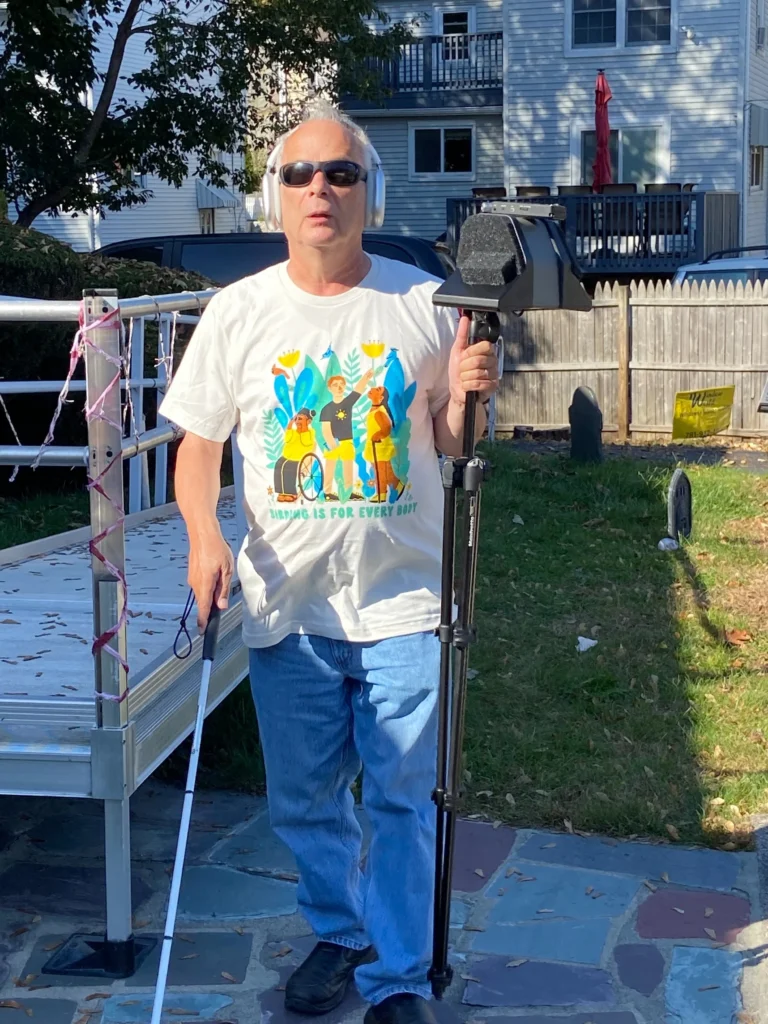
One of our Birdability Captains, Jerry Berrier, models the Bird Collective x Birdability t-shirt. He is totally blind, and is using a long cane and a microphone to enjoy birds — not a pair of binoculars. And have a look at who else is represented on that t-shirt! Photo: Lee Berrier.
It’s likely that folks who have a visible disability, or who are BIPOC or LGBTQIA+, are well aware of how often they do not get to see themselves represented in photos of bird festival outings, or in ads from optics companies, or in a lineup of speakers for an online program. Kids holding these identities, in particular, may not realize (often unconsciously) that they, too, can be birders, if they only only see older walking people birding, for example, and never anyone using a power wheelchair. We want more photos of birders with access challenges, and of birders who share multiple marginalized identities, out in the world, on birding and nature organizations’ Boards, leading outings, and amplified by birding magazines. Because representation matters!